Showing posts with label techniques. Show all posts

Wednesday, March 26, 2014

Testing a new transfer method

I've been thinking on this for a while now, because sketching directly on a canvas with watercolor ground is not a very satisfactory experience. Especially with fine point mechanical pencils. It works a little better with a more blunt softer lead. But it makes transferring sketches difficult.

I decided to try something I did long ago in college, back when I was doing intaglio printmaking. There's a technique called Chine-collé where you take some lightweight paper (like fancy Japanese rice papers) and bond it to a heavier surface for support.

I dug up some rice paper I bought a long time ago when my husband wanted me to teach him traditional Chinese brushwork. It's light, very porous, and extremely absorbent. I traced and refined my sketch on the rice paper.

I then took my canvas and with a wide flat brush applied a layer of watercolor ground over the whole surface. 

While everything was still wet, I laid my rice paper sketch directly into the watercolor ground, making sure there were no air bubbles. I gently wet the upper surface. Can't brush it because the moistened rice paper was so delicate it tore and wrinkled very easily.

I let it dry overnight, and was very happy with the way the rice paper had adhered. I then took transparent watercolor ground (I've only used the White before. This is my first time using the Transparent) and painted a thick layer over the top of everything. This is where I am currently, letting that layer dry. I'll be applying another layer, and then sanding it smooth before painting.


Here's a smaller mini 3x3 inch canvas where I followed the same steps as I did on the larger canvas, in parallel. It's my test, to see how the paint will sit on the final surface. I only did one layer of ground on top of the rice paper for this small one, and There is a lot of absorbancy of the pigment, I think because the rice paper might still be exposed a little too much. But in general I'm pleased with how it's working out. I think the secondary layer of ground on my larger piece will fix any excess absorbancy.


Sunday, March 23, 2014

Natural Plant Pigments

I spent the day at the Berkeley Botanical Gardens, at a workshop taught by Judi Pettite on the making of, and use of plant pigments in dyes and inks. To those of you who have been following me for a while, you know I'm a big fan of the natural plant pigments that Kremer Pigments used to sell. They've since discontinued that line. But something about plant pigments has really drawn me in. I've been meaning to try and make my own Nettle pigment at some point, and after this workshop, I definitely want to make it, as well as many others.


Generally, you take plant matter, make an infusion in water, reduce, dry, grind, to create pigment. From there, various binders can be added to create the paint medium of choice (Gum arabic, for watercolors). I was surprised at the range of plants that could be used, and rather pleased that one of the banes of my backyard gardening existence (oxalis) can be used to make a very pretty yellow color, simply by soaking the flowers in water for a couple of days.

Japanese maples can be used for a variety of colors ranging from browns and reds to purples.
 
Oak galls, or black walnut hulls can be crushed and soaked in water for a week, then boiled, reduced, and dried, for a deep brown or black.

The artist geek in me was very happy to play with all the bottles and jars of powders, pastes, and dyes.


* * *

Watching a demonstration of how to apply the pigment and make it into a printmaking ink. This involved grinding and mixing with gum arabic, water, and sodium alginate (an emulsifier that adds a kind of tacky viscosity to the ink).

Experimenting. Eye-dropped some oxalis dye onto a wash. I liked how the yellow droplets gleamed like gold.

Further experimentation. Crow quill pen dipped into brazilwood ink, wet in wet with eye-dropped oxalis dye.

Playing with linocuts. Quick little birdy, charged up with indigo ink.
 

* * *

At the end of the day:


Saturday, March 1, 2014

About Art References

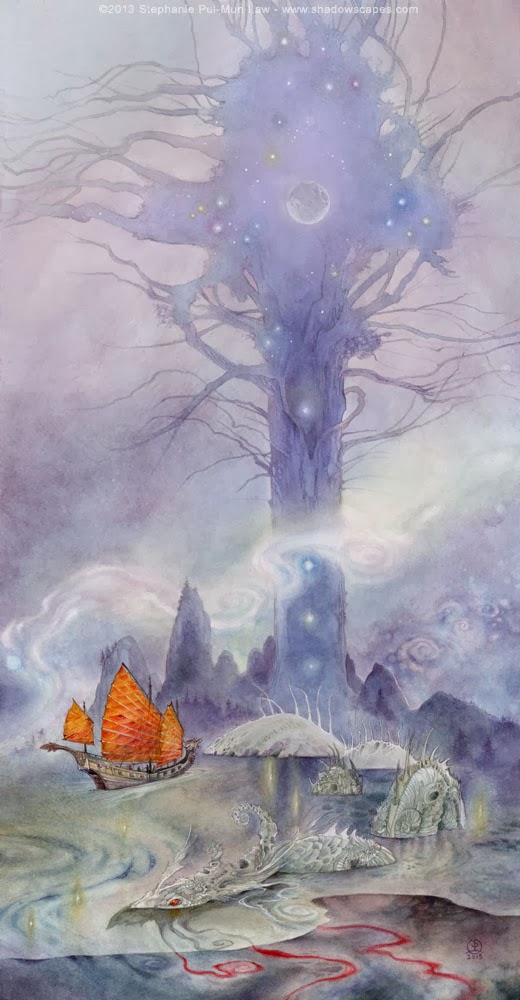
http://www.shadowscapes.com/image.php?lineid=23&bid=994
"Ships Passing in the Night"
Prints ($16.95 & $26.50) available -here-


A question I was asked recently:
How much do you use references for animals in particular?  

At this point, I mostly do birds from my imagination. Other animals I usually need at least a few reference pictures. I don't ever draw directly from any one photograph. Here's a pinterest board I use for gathering references on any one particular piece that I might be working on at a time: http://www.pinterest.com/puimun/references/

You can get a pretty good idea looking there, what my painting of the moment is. I like to gather a lot of angles and really start to form a picture in my mine about how something moves, because movement is always utmost important to me. I want my paintings to be active in some way, even when the subject is still, there is movement in all the interconnected elements.

Often photos are of static poses just because of the nature of what it is - a photographer waiting for a moment, and the difficulty of capturing spontaneous movement. For example, it's very hard to find any reference of a bird flying AT the camera because usually a bird will be seen in profile, or flying away from the photographer. You're also not going to be able to find lions pouncing out at the viewer either because...well...that might be the last photograph the photographer would ever take.

So I have to examine the anatomy and figure out how things would look from angles that are not seen. If you scroll down through that pinterest board, you can see that I've got a ton of stag photos currently, and going back a few weeks armadillos, owls, moths, chinese junks, monasteries, running children...etc.

Tuesday, December 17, 2013

Magpies: Four for a Boy

http://www.shadowscapes.com/image.php?lineid=23&bid=1006
Size: 6.5x6.5
Medium: Mixed - Watercolors, India ink, ballpoint, watercolor ground, metallic powder
For prints ($16.95), and more detailed closeup views, -click here-

One for sorrow
Two for joy
Three for a girl
Four for a boy
Five for silver
Six for gold
Seven for a secret
Never to be told.

 * * *

I tried to take more in-progress scans this time around because people keep asking about these recent paintings and how I do the textures. 

This was the initial thumbnail sketch idea.

Again, as with the others in this series, I've done very little initial sketching on the drawing board before diving into the painting. This is all I sketched:
 
These are my main materials for the painting:
 
Daniel Smith Watercolor Ground - It's an opaque white that you can paint watercolors on top of. Suggested uses are so that you can prepare non-porous surfaces for watercolors as I did with miniature pendants earlier this year (-here-), but I have also been using it in my regular paintings for "resetting" areas of the painting and turning it back to white, if that makes any sense. It differs from just using masking fluid or avoiding painting an area because I can gradate the opacity. So it creates a water-proof scumble effect. 

Daniel Smith Metallic Watercolors - This is made from metal powder mixed with binder. You can mix it with watercolor. My friend gave me a box of these that he had sitting around for a long time. And for a long time I then had it sitting around for many years. I wasn't quite sure what to do with them after initial experiments because it's kind of strange stuff. It doesn't apply in a smooth metallic surface. But it's not just fancy glitter-powder either. It's kind of something in-between. I don't know what initially prompted it, but for some reason I mixed it with some Winsor & Newton India Ink last year.

Winsor & Newton India Ink - So...I haven't tried this with other types of ink. I'm not quite sure if it's the binder in the india ink, or the pigment particles themselves. But for some reason when I've mixed it with the metallic watercolors, I start to get strange clumping textures. as the binder and pigment and particles separate.

And of course, my watercolor paints.

 Throw it all together. Let it all drip. See what happens. This is the "messy and I-hate-this-painting" stage. Working past it is the hardest part.

Started layering some bits of watercolor ground back in for lightened areas.

Oh yeah, and I forgot about ballpoint pen too. That's the other new item that I've been adding to the mix.  Specifically SKB ballpoint pens that Allen Williams introduced me to.

http://www.shadowscapes.com/image.php?lineid=23&bid=1006

Thursday, July 11, 2013

Chasing a Dream

Size: 20x12 inches
Medium: Mixed
 Prints ($16.95 for 8.5x11 and $26.50 for 11x17), original painting ($1500.00), and detail closeups available -here-
Some of the sketches and photos of the process:
Starting off as scribbles in the sketchbook. I considered several different compositions initially as thumbnails.

Settled on this composition, although you can see this was not what the final piece ended up with. This was just the initial starting point, but after considering it for a while, it felt far too static, because the fish was on a horizontal plane above the ground, and it was all viewed from a very stable and flat perspective.
 So I decided to add a little more excitement to it. Tilted the ground to make it into a steep hillside that the children are tumbling down. It gives them more of a sense of movement and speed. (Both of these composite sketches were done by scanning all the initial sketches first and then taking the thumbnails and pasting the sketches of the children throughout, fiddling with size and angles and placement).
 I liked the second composition better, so I went forward with it, finalizing the sketch onto the illustration board for painting.
 Then the color rough to make a mockup of the final painting. I scanned the finalized sketch, then put it onto a separate layer in photoshop, set to multiply. Under that layer, I cut and paste some texture segments from other paintings and fiddle with the color settings on select areas to give myself an approximate simulation of what a final piece might look like. I really don't like doing color roughs, but I've found lately that they are immensely helpful in forcing me out of my "color comfort zones". I have certain color combinations that I use frequently, and that are easy to fall back on because I know that they work. Doing a color rough lets me try out combinations that I might not otherwise have thought to do.

 One of my favorite little parts is this little corner, where I was able to retain the india ink texture in the initial wash. If you've been following my blog, you'll know that lately I've been experimenting a lot with mixed media. Primarily utilizing india ink to create darker pieces, and textures. In most of those pieces I've been throwing the ink and paint onto pieces of illustration board, letting it dry, and only then trying to "see" the image inside the splatters (like seeing pictures in the clouds). It's a very freeing and fun exercise, and I've been enjoying both the process, and the results. Now I'm really wanting to try harness those techniques into more deliberate pieces, where I dictate the subject and composition, rather than pure randomness.


Sunday, May 5, 2013

Playing with Paint

Sometimes you just have to mess around to stir things up a bit. I had a dream a couple of weeks ago, and I wanted to paint it. And by the way, though I've been asked it often, I rarely if ever paint my dreams. They're way too boring and prosaic to make good images. I mean, unless you like to see a painting of an artist freaking out after forgetting to pack or ship things to a convention (That's an illustrator's version of the stereotype "Student's Nightmare"...you know, going to school and finding out that it's final exam time for that history class you never signed up for, and by the way, it's in French).

Anyway, getting sidetracked. So I DID have a dream I wanted to paint. But it involved much darker tones and saturation than I usually get. So I dug through the closet and pulled out everything that looked like it might be useful, which included: Stamp pad refill ink, India ink, metallic watercolor medium (that a friend gave me from a stash he found in his closet, thank you Stephen), granulation medium, frisket, rubbing alcohol, and scrap pieces of illustration board, some with washes that I had started once upon a time then discarded. 

I set about making a mess with those. And after a half hour of fun, I had this:

I propped them up to let the ink drip down the page (ala Jackson Pollack & UC Berkeley's stuck-in-the-60's art classes!) making bigger runny messes on my desk and drawing boards. After that, I walked away and waited for them to dry.

Over the next week, I've done these pieces with the results of that initial ink-mess. With the addition of Daniel Smith watercolor ground (for the broad areas of white), white gel pen, and watercolors. My initial impulse to paint that dream hasn't really materialized in any of these, but they've spawned a host of other images. It's a very un-planned process. I'm just looking into the shapes that the texture of drying paint and ink leaves, and then pulling out details and focusing them into images.


These have all been relatively small pieces. Hopefully you'll be seeing some of these techniques combined with my standard Steph-watercolors for some larger and more ambitious images in the near future. I have some ideas of where to go with it, but so far it's rather nebulous.

Monday, October 22, 2012

Joy - In progress sketches

It has been requested, so I'm going back through these last six pieces and posting the in-progress sketches and phases. First up, Joy.

Joy
Medium: Watercolors
Size: 9x12 inches
Prints available: -here-

Each of the cards for the Dreamdance will be based on a dance form. For this one it is a veil bellydance.

 The very first sketch. I liked the flow of it, but was not initially happy with it. Funny enough, it ended up being the winner, with a few tweaks.


Tried scribbling a few random thumbnails to get some concept for a composition. Liked the figure on the lower right, so tried expanding on that one.


Attempted to see where that one would take me. I liked where it went, but it didn't fit into the framework of "Joy". Set it aside for possible future painting. But not what is needed here and now.
 

Went back to the first sketch. Didn't like something about the head position, so tried resketching it with a slightly different angle for the head. Ding! That was it!

Fleshed out the rest of the composition. Wanted the "veil" to be wispy clouds and wind, as she's so high up. Satyr was worried initially after seeing this sketch that it might look like smoke swirling up from fires down below. But I had colors vaguely in mind for it already and didn't think that would be a problem. Set the horizon at a wild tilt, for a less static background.

...because it would be bright green! So, I tried something a little different here than usual, technique-wise. I knew I wanted a green-ish tint to it all. But it's a delicate balance if making the whole sky greenish too, not to take on a sickly hue. I wanted some bright spots of red as well. And, personal taste, I generally try to stay away from circling the whole color wheel. As in, I like to try to stay within a 2/3rds section of the color wheel, to avoid a rainbow look. Contrasting colors also good. But if I wanted red and green, I didn't want blue. So I took the sketch into photoshop to try to see what I could do about striking that balance.

In the past, I've just scribbled in photoshop brushes to give myself a rough idea of colors. But it's hard to get a real good idea of what that looks like for watercolor, because I can't get the color shifts and irregularities. So instead of just painting directly, I took a big section of sky from one of my other paintings (I think it was Wind Machine) and pasted it into a separate "multiply" layer. Then I fiddled with the color balance of various selections on that layer, until I was satisfied with the overall color scheme.

I used that photoshopped thumbnail as a guideline for my colors as I started to paint.

Turned out, it worked fairly well in helping me press to some color subtleties and interactions I otherwise would not have done!
 
 
In-progress shots of the other 5 pieces will be coming in the next week!