Showing posts with label art books. Show all posts

Tuesday, July 24, 2012

Magical Menagerie


Magical Menagerie is finally released! My usual custom sketch option is available on this (it'll be on the inside back cover because there's no endsheets on softcover books).

Finished the manuscript in early 2011, so it's been a while getting from there to print and bookstores. I remember how anxious I was when I did my first Dreamscapes book about how long the publication process is. Generally it takes about a year. That is time enough to feel like a kid counting down the endless days until Christmas!

These days though, with book 3 out the door, as well as the Shadowscapes tarot, I've had more practice at being patient. Just try to forget about it once it leaves my hands. That's the best as an artist anyway, isn't it? For each painting, each drawing, each sketch. The satisfaction of a finished piece shouldn't be the goal. It's the process that's paramount, always. The moment of creating, itself. And then - It Is Done. What comes next is the most important, not what came before. Always moving, always growing, always exploring, always creating.

Here's a peek inside the book!
Managed to fit in some really nice two-page spread showcase pieces as well, so in addition to the techniques and tutorials and sketches, there's a lot of finished art to look at.

Wednesday, June 20, 2012

Book sketches

Had some people asking how detailed and how big the sketches are I do inside the books (when you order one of my books with a customized sketch option). So here is a sampling of some of them that I've done this week:


Friday, April 13, 2012

Between the Seams - Art Book Preview!

Apologies for being rather silent lately. But I've got good reasons! The art book! It's done! It's off to the printer, and hopefully within a month or so I'll be able to start taking pre-orders. Over 100 pieces of artwork from the past 10 years are included in this full color volume. Tarot pieces are not included, since those can be found in their entirety in my other books. Here's a peek inside:

Sunday, February 19, 2012

Cover Poll for The Art Of

It has often been requested over the years, and I finally felt ready to produce this. Coming soon, later this year. It's in the design stages still, but here are some cover options I'm considering. Your feedback on which one you like will be appreciated! Just leave a comment on which one you like the best:

#1

#2

#3

#4

#5


Thursday, November 5, 2009

Designing Knotwork

Knotwork design can be very daunting. Someone was just telling me today that when she asked an artist at Dragoncon who utilized a lot of knotwork in his portfolio how to get started, his response amounted to, "you just feel it."

Unhelpful as that sounds, it does eventually come to that. But having some basic understanding of how to construct a very simple design, and the underlying patterns to create the weave are a necessary starting point. With enough practice from there, you do just start to feel it, and it becomes less of a technical nightmare.

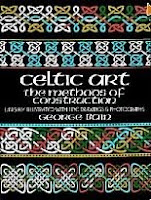
Artist Cari Buziak has several free tutorials to get you started on knotwork, and the book that I learned from and found to be the most helpful was Celtic Art: the Methods of Construction, by George Bain.

However, the method of instruction he uses is very compact and concise, and might be confusing to some people, though it worked quite well for me. He does cover all types of designs, including knotwork, spirals, key patterns, and anthropomorphics.


* * *

Initial Concept

This particular commission was for a circular knotwork piece incorporating coyote(s) and bear(s), so I start with sketching out some guidelines. The circle itself, as well as separating it off into segments.

With the two animals to work in, I can either choose to create a non-symmetrical design, or else portion off the circle and create a repeating pattern. I chose to the do the latter for this, and divided the circle up into thirds (with a subdivide in each segment so that half is the coyote, half is the bear).

I then can roughly sketch in how the animals will fit into the design. You can see how I pull the coyote's tail down into the adjacent segment -- eventually it goes much further than that even, but this helps to tie the whole design together so that it's not just 3 big pie slices in their separate containers, but a melded whole.

* * *

Scanning and Propigating the Pattern

Here's where the joys of the digital age kick in. Once I have the basic structure in mind for one segment of the pie, I scan it in.

Digitally, I take that segment and rotate it 120 degrees to fill in the rest of the pattern. I now have a framework of the pattern to work with.

At this point now I can see how the segments will interact with each other. I print this rudimentary pattern out.

* * *

Elaborating on the Basic Pattern

With a sheet of tracing paper I can elaborate on the pattern. Being able to see how the segments will interact, I can now pull the coyote's tail through from one segment into the other, weaving it into the aspects of the design in the adjacent segment, and also fill in the dead spaces (like that upper left triangular segment you can see in this sketch on the right). I can also fill in some filler knotwork patterns as well inside the bear, coyote, and surrounding areas. This is where basic understanding of knotwork design comes in. I don't bother with the grids and dots and things explicitly any longer, but it's there in my head still, and helps when laying this type of stuff out.

* * *

Scanning Again

I scan in the results of that refined sketch, and once again (copy, paste, rotate 120 degrees) x 2 to see how the full design will look, and to make sure that all the adjacent segments line up properly.

There's a little awkwardness with the coyote's tail not lining up properly as it crosses over into the next segment, and the triangle overlaps the coyote's back too much, but those can be fixed in the next round. This gets printed out once again.

* * *

Final Tweaking

Once more, I lay a sheet of tracing paper over the print, and sketch out one entire segment. This will be the sheet I use for transferring to the final painting surface, and so I sketch out the whole circle, as well as the small spiral patterns at each third to use for lining things up, because the next part happens without any more digital aid. No more quick "rotate 120 degrees" with the click of a button!

Once this is done I go through my usual sketch-to-illustrationboard transfer method. I lay the sketch face down on the final painting surface, and tape it securely. I then burnish the back side of the sheet (fingernail works fine for this), and it transfers the lead from the tracing paper to the illustration board. I rotate the sketch 120, lining up the circles, tape it once again, and repeat.

* * *

The End Result

After all that sketching and re-sketching, here's the final result, ready to be painted.


Wednesday, October 7, 2009

Realms of Fantasy Sketches

For an upcoming Realms of Fantasy issue, an illustration for a story "Sultana Lena's Gift".

After reading the story, my copy of The Rubaiyat of Omar Khayyam came to mind, with its lovely illustrations by Edward Dulac. Browsed through it for inspiration and to get my mind flowing in the right direction for the imagery.

Also key in this particular short story is a little mechanical bird. I started with some scribbles in my spare time while at Gencon a few months ago, exploring some ideas for the bird's design in a few ink drawings.


And now that the zodiac is done (with its more urgent deadline), a few months later I'm finally having the chance to go back to this project. The final rough concept sketch for the painting:
Stamp of Art Director approval on it, and so all set to move on to a much more detailed sketch and the painting! I love doing work for Realms of Fantasy, as the art director (the old one, and my so far very short acquaintance with the new one) seem to send fitting stories my way. From there, I read the story and pretty much can paint anything I want.

* * *

Meanwhile, it's been rather noisy outside my studio window today as I said goodbye to a 50 foot tall black acacia tree in my backyard. Unfortunately it has suffered from root rot after the previous owner of the house put in extensive landscaping terraces in the backyard just before selling it to us. It's taken two years for the results to be evident but a few months ago Dana and I had to reluctantly admit that the tree was dead and would need to be taken down. It'll be sad to see that large gap in the sky where it used to be. Even mostly dead and only as bare branches it had a stark grace and was nice to shield us from the neighbors.

I'm sure some something will quickly grow in that space though. If the black acacias in the yard had their way, this whole plot of land would be an acacia grove, from all the saplings I'm constantly finding popping up in awkward spots.

* * *

Also, a new art book to add to my bookshelf arrived in the mail today. I've never actually played guild wars, but after seeing some of the artwork in this shown on other blogs, I ordered one. It features all digital artwork, but I find often that some of the art that I enjoy looking at the most is that which is most different from my own.

Wednesday, August 19, 2009

Zodiac - Cancer In Progress

Progression for Cancer.

When I first get a description for a piece, I start with sketches and thumbnails. In the case for this zodiac series, I was given a series of keywords and colors. I like working with this kind of very loose guidance for a commission because it leaves me free to come up with my own connections to the concepts. In this case: the crab, water, nurturing, the reflective surface of water (for the colors), focus on the family, protective, sensitive.
* * *
Once I have a basic sketch worked out, and the composition pieced together in Photoshop, I send it off for approval from the art director. When I get the okay, then I start to flesh out the details and correct anatomy with references if needed. In this case the latter required looking up pictures of seagulls, crabs, and lotuses. When I do the first concept sketches I don't worry so much about the accuracy of things like that, wanting instead to capture the flow and mood of a piece.
I picked up a couple of Audubon books for fairly cheap the other day from Costco with great references for all sorts of birds and animals.

Though of course the internet never fails for image references as well.

* * *
Transferred to the final painting surface (Strathmore 500 series illustration board), I refine the details even more. By flipping the image back and forth several times during process, it allows you to get a fresh perspective on the composition and work out any imbalances that might otherwise be overlooked. Working on a piece for too long, everything starts to look right. Flipping also helps for spotting strange anatomy flaws. When working with a symmetrical (or even semi-symmetrical) piece, looking at it in reverse is extremely useful.
All set for painting now. Just awaiting the final okay from the art director!